Organisations & Enterprise
 Government
.png?width=20&height=20&name=icon%20(1).png) Universities
Universities.png?width=20&height=20&name=icon%20(2).png) Associations & Communities
Associations & Communities Increase Employee Engagement
.png?width=20&height=20&name=icon%20(3).png) Reduce Employee Turnover
Reduce Employee Turnover.png?width=20&height=20&name=icon%20(4).png) Provide Leadership Development
Provide Leadership Development.png?width=20&height=20&name=icon%20(5).png) Develop High Potentials
Develop High Potentials.png?width=20&height=20&name=icon%20(6).png) Boost Diversity, Equity & Inclusion
Boost Diversity, Equity & Inclusion.png?width=20&height=20&name=icon%20(7).png) Support Career Development
Support Career Development.png?width=20&height=20&name=icon%20(8).png) Drive Collaboration & Innovation
Drive Collaboration & Innovation.png?width=20&height=20&name=icon%20(9).png) Onboard New Staff & Graduates
Onboard New Staff & Graduates Brancher Mentoring Software
 Strengths & Values Analyzer
 Mentoring Program
 Reverse Mentoring
 Group Mentoring

 Organisations & Enterprise
 Government
.png?width=21&name=icon%20(1).png) Universities
Universities.png?width=21&name=icon%20(2).png) Associations & Communities
Associations & Communities Increase Employee Engagement
.png?width=21&name=icon%20(3).png) Reduce Employee Turnover
Reduce Employee Turnover.png?width=21&name=icon%20(4).png) Provide Leadership Development
Provide Leadership Development.png?width=21&name=icon%20(5).png) Develop High Potentials
Develop High Potentials.png?width=21&name=icon%20(6).png) Boost Diversity, Equity & Inclusion
Boost Diversity, Equity & Inclusion.png?width=21&name=icon%20(7).png) Support Career Development
Support Career Development.png?width=21&name=icon%20(8).png) Drive Collaboration & Innovation
Drive Collaboration & Innovation.png?width=21&name=icon%20(9).png) Onboard New Staff & Graduates
Onboard New Staff & Graduates Mentoring Software
 Strengths & Values Analyzer
 Peer Mentoring
 Reverse Mentoring
 Group Mentoring
 HR Mentoring Program
Boost engagement with ready-to-use mentoring program email templates. Guide mentors and mentees, build momentum, and deliver measurable results.
Most mentoring programs lose momentum because participants stop hearing from you. Silence kills engagement faster than any mismatch or admin problem. That’s why you need strong mentoring program email templates in place from day one.
Not generic reminders, but actual monthly prompts that guide mentors and mentees through a structured development journey.
Research backs this up. A study reported that employees with mentors are significantly more engaged and more likely to stay, but only when the relationship is active and supported consistently:
This guide gives you the full communication plan. Clear goals, practical direction, and a consistent message rhythm that keeps people engaged without extra admin. Pair it with Brancher’s automated nudges every 30 days, and your program becomes more predictable, better supported, and easier to run.
TL;DR
Most mentoring programs lose momentum when participants stop hearing from program administrators. A structured monthly communication plan keeps mentors and mentees engaged, builds trust, and drives measurable outcomes. This guide provides a month-by-month email strategy, covering purpose, goal-setting, communication, challenges, career development, skills, leadership, and program wrap-up. Pair these emails with Brancher’s automated nudges every 30 days to reduce admin, maintain momentum, and ensure consistent, high-quality mentoring relationships.
Table of Contents
- Introduction
- Brancher’s Mentoring Program Email Templates to Send Out Each Month
- How Brancher Supports Engagement Automatically
- Get Our Mentoring Email Template Toolkit
- Frequently Asked Questions
Brancher’s Mentoring Program Email Templates to Send Out Each Month
Here is Brancher’s complete month-by-month breakdown, packed with context, clear development goals, and actionable steps you can use immediately. Treat these emails as a foundation—customise the language and examples to fit your organisation and make them feel authentic.
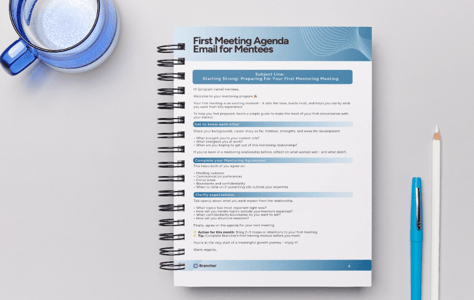
Month 1: Starting Strong, Purpose and First Meeting Agenda
Your program lives or dies by the first meeting. Month 1 is where you remove awkwardness, reduce confusion, and get pairs into action. When mentors and mentees know exactly what to discuss in their first meeting, they start the relationship with clarity instead of hesitation.
This email should do more than say “book your first catch-up.” It should guide them into meaningful setup work. Research shows that early expectation setting significantly improves mentoring outcomes.
What you reinforce in this email:
- Discuss purpose and expectations
- Agree on confidentiality
- Align on communication preferences
- Set meeting frequency
- Use a simple first meeting agenda
You want both people walking away with a shared understanding of why they’re meeting and how they’ll work together. When this foundation is strong, later months become easier and more productive.
Month 2: Personality, Values and Working Styles
By Month 2, the relationship is forming, but trust is still shallow. This is where you help pairs understand each other with more depth.
When mentors and mentees explore their values, work styles, and communication preferences, the mentoring relationship becomes smoother and more psychologically safe. The Australian HR Institute reinforces that rapport and trust are critical to mentoring success.
Your Month 2 email should encourage:
- Talking about what motivates them
- How they prefer to communicate
- How they make decisions
- Their personal values
- Their personality preferences
The goal is to normalise differences and build self-awareness early so neither party takes miscommunication personally later.
Month 3: Goal Setting
By now, your participants know each other. Month 3 is the moment you turn connection into direction. Without goals, mentoring becomes a friendly chat. With goals, it becomes development and career progression.
Your email should guide mentees to articulate what they want from the program and help mentors turn vague aspirations into actionable goals. Harvard Business Review highlights that structured reflection and goal clarity improve performance by up to 25%.
Push participants to explore:
- What they want to achieve
- Why it matters
- How they will measure progress
- When they aim to achieve it
- What support they need
Clear goals create a roadmap for every discussion that follows.
Month 4: Confident Communication and Questioning
Most mentoring relationships stay surface level because people don’t know how to have honest, meaningful conversations. Month 4 focuses on building communication capability so pairs can unlock deeper insight.
You are encouraging mentors to use strong questioning techniques and mentees to articulate their thoughts clearly. You also want them both to improve at active listening, curiosity, and honest discussion.
CIPD reinforces that high-quality mentoring depends on communication skills and structured conversation. Guide participants to:
- Ask open, curious questions
- Practise active listening
- Share their perspectives openly
- Clarify misunderstandings early
- Reflect on what was discussed
When communication strengthens, everything in the mentoring relationship improves.
Month 5: Working Through Challenges
Every mentoring relationship hits friction. Busy schedules, shifting priorities, personal uncertainty, stalled progress. Month 5 equips pairs to handle these challenges instead of ignoring them.
This email is about normalising difficulty, encouraging transparency, and showing mentors and mentees how to recalibrate. Programs that fail often do so because participants don’t know how to navigate discomfort or change.
Gartner reports that teams who address barriers directly experience higher engagement and more consistent follow-through.
Encourage pairs to:
- Call out barriers early
- Discuss root causes
- Brainstorm practical solutions
- Reset expectations and next steps
- Recommit to progress
This is where resilience starts building in the relationship.
Month 6: Career Development and Networks
Month 6 shifts attention from internal reflection to external opportunity. You want mentees expanding their visibility, exploring new pathways, and learning from people outside their immediate team.
McKinsey’s capability-building research shows that experience-based learning is one of the strongest drivers of skill progression.
Use this email to encourage:
- Understanding career pathways
- Identifying skill gaps
- Exploring industry knowledge
- Meeting relevant stakeholders
- Observing or shadowing new environments
This is where mentoring starts shaping real career outcomes.
Month 7: Productivity and Sustaining Momentum
Around the midpoint, motivation naturally dips. Workloads rise. People forget their early enthusiasm. Month 7 helps pairs stay consistent by focusing on simple productivity habits and celebrating progress.
Your message should remind participants that momentum is built through small wins, not grand leaps. Harvard research shows that small daily progress increases engagement and long-term commitment.
Push pairs to:
- Review progress from the last 30 days
- Recommit to one clear priority
- Keep meetings short and focused
- Use micro check-ins if schedules are tight
- Celebrate even minor wins
This prevents the common drop-off that derails mentoring programs.
Month 8: Feedback and Growth Mindset
Month 8 is where real growth happens. Feedback strengthens the relationship, builds trust, and helps mentees refine their skills. But only if the environment is safe and constructive.
Your email should guide mentors and mentees to exchange feedback openly, without defensiveness. Introduce the idea that feedback is not criticism. It’s data for improvement.
Encourage pairs to discuss:
- What has worked well
- What has not worked as well
- What the mentee should try next
- How the mentor can support more effectively
- How both parties want to improve
This builds maturity, confidence, and trust in the relationship.
Month 9: Skills Development and Capability Building
Now that goals are clearer and the relationship is strong, Month 9 pushes mentees into applied capability building. This is where you shift from discussion into action.
Mentors can coach mentees through real tasks, encourage stretch work, or help them train specific skills tied to their career goals.
In this email, encourage:
- Identifying specific skills aligned to goals
- Practising new tasks in a safe environment
- Taking on stretch or shadowing opportunities
- Reviewing strengths and gaps honestly
- Building competence through repetition
This month connects the program to tangible career outcomes.
Month 10: Leadership Behaviours and Confidence
Leadership is not a title. It’s a behaviour. Month 10 focuses on helping mentees identify and practise leadership behaviours within their current role, even if they do not manage people.
AICD research reinforces that leadership capability is a strong indicator of career progression and organisational impact.
Your message should prompt discussions on:
- Self-awareness and emotional intelligence
- Decision making
- Communication under pressure
- Influencing and stakeholder management
- Building confidence through action
The goal is not to turn mentees into managers. It’s to help them show leadership through behaviours, not hierarchy.
Month 11: Wrap Up, Reflection and Future Planning
Your final month should guide pairs to close the formal relationship with intention, clarity, and confidence. Endings matter. They consolidate learning and help mentees recognise how far they have come.
Without structure, wrap-ups become rushed or awkward. Your email gives the framework that helps both mentor and mentee reflect and plan forward.
In this email, encourage pairs to:
- Reflect on goals
- Document key learnings
- Identify achievements
- Discuss what happens next
- Decide whether to continue informally
This is where the mentoring journey becomes a lasting development milestone.
How Brancher Supports Engagement Automatically
Even the best communication plan fails if it relies on manual effort. That is why Brancher sends automated nudges every 30 days, prompting mentors and mentees to stay consistent, check in, and follow the best practice activities you are reinforcing in your emails.
The behavioural science is clear: Well-timed nudges significantly increase follow-through and habit formation:
Through our nudges, you can:
- Keep the relationship active
- Reinforce program milestones
- Reduce admin for HR
- Prevent participant drop off
- Support quality conversations
This is how you run a mentoring program that scales without losing its human connection.
Get Our Mentoring Email Template Toolkit
These monthly mentoring program email templates give you a real communication strategy, not a token reminder. Use them to guide your participants through a structured development journey that builds confidence, capability, and commitment.
Customise where needed, pair them with Brancher’s automated nudges, and you’ll run a mentoring program that stays active and delivers measurable outcomes.
Download our Mentoring Email Template Toolkit to get ready-to-use emails for every month of your program. Customise them to suit your organisation’s culture, pair them with Brancher’s automated nudges, and you’ll run a mentoring program that stays active and supported, delivering measurable results.
Your program doesn’t have to lose momentum. Grab the toolkit and start sending emails that actually make a difference.
Frequently Asked Questions
Why do mentoring programs lose momentum?
Mentoring programs often stall because participants stop receiving guidance and prompts. Without consistent communication, even engaged mentors and mentees can disengage.
How can monthly emails improve mentoring engagement?
Monthly emails provide structure, guide meaningful conversations, reinforce goals, and support skill development. Regular contact ensures mentoring remains active, purposeful, and measurable.
Can I customise these email templates for my organisation?
Yes. Brancher’s email templates are designed to be easily tailored with your language, examples, and culture to feel authentic while following best practices.
What role do automated nudges play?
Automated nudges remind participants to stay on track, encourage follow-through, and reduce administrative workload. Combined with emails, they keep relationships active and consistent.
Are these emails effective for long-term mentoring outcomes?
Yes. Structured, monthly guidance paired with nudges helps build trust, capability, and confidence. It increases goal achievement, career progression, and long-term engagement in mentoring programs.