Organisations & Enterprise
 Government
.png?width=20&height=20&name=icon%20(1).png) Universities
Universities.png?width=20&height=20&name=icon%20(2).png) Associations & Communities
Associations & Communities Increase Employee Engagement
.png?width=20&height=20&name=icon%20(3).png) Reduce Employee Turnover
Reduce Employee Turnover.png?width=20&height=20&name=icon%20(4).png) Provide Leadership Development
Provide Leadership Development.png?width=20&height=20&name=icon%20(5).png) Develop High Potentials
Develop High Potentials.png?width=20&height=20&name=icon%20(6).png) Boost Diversity, Equity & Inclusion
Boost Diversity, Equity & Inclusion.png?width=20&height=20&name=icon%20(7).png) Support Career Development
Support Career Development.png?width=20&height=20&name=icon%20(8).png) Drive Collaboration & Innovation
Drive Collaboration & Innovation.png?width=20&height=20&name=icon%20(9).png) Onboard New Staff & Graduates
Onboard New Staff & Graduates Brancher Mentoring Software
 Strengths & Values Analyzer
 Mentoring Program
 Reverse Mentoring
 Group Mentoring

 Organisations & Enterprise
 Government
.png?width=21&name=icon%20(1).png) Universities
Universities.png?width=21&name=icon%20(2).png) Associations & Communities
Associations & Communities Increase Employee Engagement
.png?width=21&name=icon%20(3).png) Reduce Employee Turnover
Reduce Employee Turnover.png?width=21&name=icon%20(4).png) Provide Leadership Development
Provide Leadership Development.png?width=21&name=icon%20(5).png) Develop High Potentials
Develop High Potentials.png?width=21&name=icon%20(6).png) Boost Diversity, Equity & Inclusion
Boost Diversity, Equity & Inclusion.png?width=21&name=icon%20(7).png) Support Career Development
Support Career Development.png?width=21&name=icon%20(8).png) Drive Collaboration & Innovation
Drive Collaboration & Innovation.png?width=21&name=icon%20(9).png) Onboard New Staff & Graduates
Onboard New Staff & Graduates Mentoring Software
 Strengths & Values Analyzer
 Peer Mentoring
 Reverse Mentoring
 Group Mentoring
 HR Mentoring Program
How Long Does Mentoring Software Take to Implement? Learn why most organisations launch in 6 to 12 weeks with the right rollout, matching, training, and support.
If you’re comparing platforms, you’re no longer at a stage where you’re asking what the software does; you’re asking how long does mentoring software take to implement before your team gets buried in setup, approvals, training, and follow-up.
Fair question. On average, you can open your expression of interest form in 6 weeks and have participants matched in 9 to 10 weeks.
The important part is this: that timeline is not driven by our software taking weeks to configure. It is usually driven by your internal project management, stakeholder approvals, communications, and optional IT integration work.
TL;DR
If you want the short version, here it is.
We can open your expression of interest form in 6 weeks on average, and your participants are typically matched in 9 to 10 weeks. That timeline is not because our software takes weeks to configure. It doesn’t. Our onboarding and setup work is measured in hours, including a 45-minute onboarding meeting, a 3 to 4 hour design workshop, and 30-minute fortnightly onboarding calls. The lead time usually sits with your internal project work, including stakeholder approvals, communications, branding, pairing criteria, resource gathering, and any optional IT integrations such as SSO, white-listing, and calendar integration. If you want a mentoring software rollout you can actually plan, staff, and launch with confidence, that is what we give you.
Table of Contents
- How Long Does Mentoring Software Take to Implement?
- What Actually Happens in the First 6 Weeks
- Why the 6-Week Lead Time Is Not a Software Problem
- What You Get Beyond Setup
- How We Support You as a Program Administrator
- Why This Matters for HR Leaders in Australia
- So, How Long Does It Take to Implement?
How Long Does Mentoring Software Take to Implement?
With Brancher, you can give yourself 6 weeks to open the expression of interest form and 9 to 10 weeks until participants are matched. That is the average timeline in our mentoring program implementation plan. It gives you a realistic runway for launch, not a fantasy number built to win a sales call.
Here is what matters for buyers comparing mentoring software implementation options:
Our work is measured in hours, not months. Our implementation plan includes a 45-minute welcome onboarding meeting, 30-minute fortnightly onboarding calls, and a 3 to 4 hour mentoring design and planning workshop.
Once the right inputs are locked in, we move quickly. The longer lead time usually sits with your side of the rollout: internal planning, approvals, communications, sign-off on pairing criteria, branding, resource gathering, custom conversation topics, and any optional IT work such as white-listing, SSO, or calendar integration.
What Actually Happens in the First 6 Weeks
Week one starts with the basics done properly. You sign the contract, join a 45-minute welcome onboarding meeting, and schedule 30-minute fortnightly onboarding calls so the rollout keeps moving.
We also run a 3 to 4 hour mentoring design and planning workshop within the first week. That workshop is where you shape the program around your goals, target group, matching approach, and support model.
By week two, your team is usually working through the follow-up actions that decide whether launch stays on track. That includes sign-off on pairing criteria, sign-off on the communications plan, and provision of your logo, branding, resources, and any custom conversation topics.
If you have several stakeholders involved, this is where time starts to stretch. Our own implementation plan makes that clear and notes that you may want to allow longer if multiple approvals are needed.
Then comes configuration and testing. We configure your setup, support any optional IT work, and run testing before the form goes live. Our implementation plan includes user acceptance testing with 3 to 5 people and a built-in buffer week to implement feedback. That is how you avoid a messy launch that creates more admin than it removes.
Why the 6-Week Lead Time Is Not a Software Problem
This is where buyers get caught. A vendor says implementation is “fast”, but nobody tells you what is actually slowing the clock. In our case, it is not the mechanics of setup.
We can move through onboarding, design and configuration quickly once your team has made decisions. The real timeline sits in the customer work around the software: getting internal buy-in, finalising messaging, aligning stakeholders, signing off matching logic, and managing optional integrations. That is why we are upfront about the 6-week lead time to open the expression of interest form. It is a project reality, not a product weakness.
That matters if your leadership bench is thin and your team does not have hours to waste. You don't need another system that looks simple in a demo but quietly depends on your team doing all the heavy lifting after signature. You need a mentoring software rollout with enough structure to keep momentum and enough support to keep the work contained.
What You Get Beyond Setup
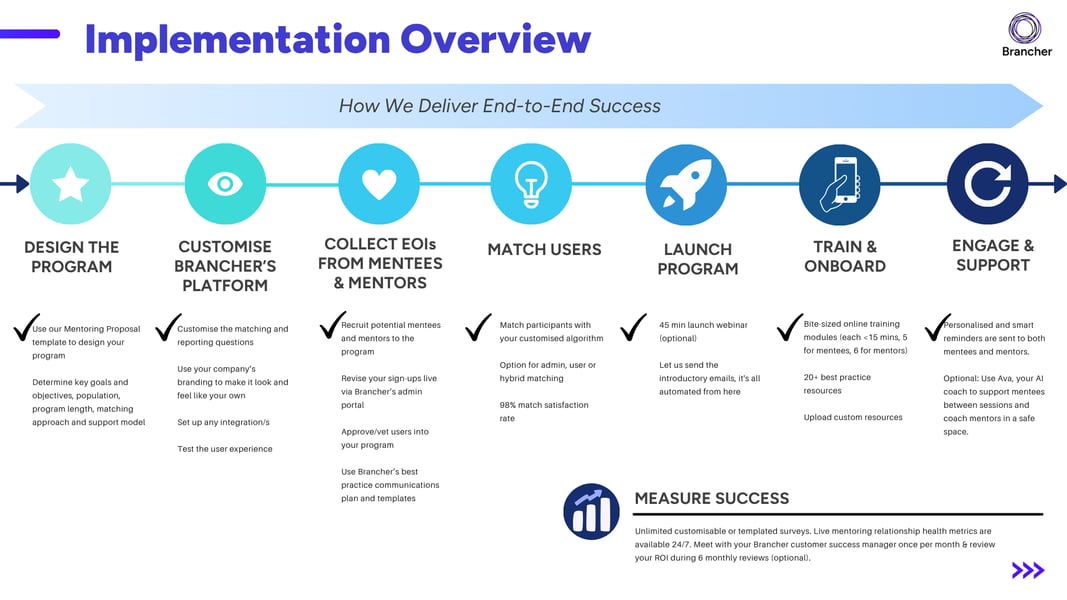
We do not stop at configuration. Our implementation approach covers the full program journey. On our rollout page, we show the six core phases as Design, Recruit, Match, Launch, Manage, Evaluate. We support you through enrolment, matching, participant launch, smart nudges, and program measurement so you are not left stitching the experience together yourself.
We also show you what the participant journey can look like over time.
In our sample mentoring program, people express interest in April, get matched in May, and kick off in June with a 45-minute launch webinar, an online mentoring agreement, and the first e-learning module.
The program then moves through goal setting in July, career development in August, leadership in September, values in October, networking in November, and closure in December. We set the expected time commitment at 1 hour per month for mentoring meetings plus 1 hour of prep or training.
That gives you something rare in mentoring software: a rollout you can actually map and communicate.
How We Support You as a Program Administrator
If you run the program, you care about one thing more than feature lists. You care whether we reduce your workload or just rearrange it.
We help you collect expressions of interest, manage sign-ups live through the admin portal, approve or vet users, and run best-practice communications. We also give you flexible matching through admin-led, user-led, or hybrid options, supported by a customised algorithm. We have achieved over 98% matching satisfaction using science-based matching built on personality, values, skills and more. Better matching means fewer avoidable problems later.
After launch, we keep the program moving with bite-sized online training modules, participant resources, and personalised smart reminders. You can also add Ava, our AI coach, to support mentees and coach mentors between sessions. Ava provides 24/7 support with personalised prompts and guidance between sessions. That helps you keep engagement up without manually chasing every participant.
We also give you visibility. Our implementation materials include unlimited customisable surveys, 24/7 live health metrics, and monthly meetings with a customer success manager, with optional 6-monthly ROI reviews. Our platform also offers admin resources, contextual nudges, and detailed reports. That means you can see what is working, where support is needed, and how the program is tracking without waiting until the end to find out.
Why This Matters for HR Leaders in Australia
If you are trying to strengthen future leaders, speed alone is not the point. A rushed rollout with weak comms, poor matching, and no follow-through gives you a program that looks active for a month and loses credibility by quarter end.
What you need is a rollout that is commercially sensible. One that gets you to launch fast enough to matter, but with enough structure to protect adoption, engagement, and outcomes. That is why we separate software setup from customer-side lead time. We can move quickly. The key question is whether your internal approvals, communications, and stakeholder alignment can move quickly too.
So, How Long Does It Take to Implement?
If you want a credible answer to how long does mentoring software take to implement, here it is.
With us, you should plan for 6 weeks to open the expression of interest form and 9 to 10 weeks to participant matching. The work we own is measured in hours.
The lead time you feel is usually driven by internal customer activity such as project management, communications, stakeholder sign-off, branding, and optional IT integrations. That is exactly why we build our rollout around clear steps, clear ownership, and clear support.
If you want to see how our rollout works in practice, start your free trial and see Brancher in action.
Frequently Asked Questions
How long does mentoring software implementation take?
With us, you should plan for 6 weeks to open the expression of interest form and 9 to 10 weeks until participants are matched on average. That gives you a realistic rollout window for planning, approvals, setup, and launch.
Why does implementation take 6 weeks if the platform can be configured quickly?
Because the platform is rarely the bottleneck. We can configure and customise your setup quickly once the core inputs are locked in. The 6-week lead time usually comes from your side of the project, including internal approvals, stakeholder management, communications planning, branding sign-off, pairing criteria, resource collection, and optional IT integrations.
How quickly can you configure the platform?
Our implementation work is measured in hours, not months. Our plan includes a 45-minute welcome onboarding meeting, a 3 to 4 hour mentoring design and planning workshop, and 30-minute fortnightly onboarding calls. Once decisions are made and inputs are provided, we move quickly.
What happens in the first few weeks of implementation?
First, we lock in your program design. That includes your goals, target audience, matching approach, support model, and timeline. Then we configure your setup, align your comms plan, support any optional IT requirements, and prepare the expression of interest form for testing and launch. Our plan also includes user acceptance testing with 3 to 5 people before go-live.
What can slow the rollout down?
The biggest delays usually come from internal customer-side work, not software setup. If you need several stakeholders to approve branding, communications, pairing criteria, legal steps, or IT integrations, your timeline can stretch. Our implementation plan explicitly notes that you may want to allow longer if multiple stakeholders are involved.
What support do you provide after launch?
We support you well beyond setup. We guide you through design, recruitment, matching, launch, management, and evaluation. We also provide bite-sized training modules, participant resources, smart reminders, and optional support from Ava, our AI coach. For program administrators, we provide live health metrics, surveys, admin resources, and detailed reporting so you can track program progress and step in early when needed.
Is this timeline realistic for large organisations?
Yes, as long as you plan properly on your side. If you have a larger stakeholder group, stricter internal processes, or more complex IT requirements, you may need more time for approvals and coordination. That is exactly why we separate platform setup time from customer-side lead time. It gives you a more credible implementation picture upfront.