Organisations & Enterprise
 Government
.png?width=20&height=20&name=icon%20(1).png) Universities
Universities.png?width=20&height=20&name=icon%20(2).png) Associations & Communities
Associations & Communities Increase Employee Engagement
.png?width=20&height=20&name=icon%20(3).png) Reduce Employee Turnover
Reduce Employee Turnover.png?width=20&height=20&name=icon%20(4).png) Provide Leadership Development
Provide Leadership Development.png?width=20&height=20&name=icon%20(5).png) Develop High Potentials
Develop High Potentials.png?width=20&height=20&name=icon%20(6).png) Boost Diversity, Equity & Inclusion
Boost Diversity, Equity & Inclusion.png?width=20&height=20&name=icon%20(7).png) Support Career Development
Support Career Development.png?width=20&height=20&name=icon%20(8).png) Drive Collaboration & Innovation
Drive Collaboration & Innovation.png?width=20&height=20&name=icon%20(9).png) Onboard New Staff & Graduates
Onboard New Staff & Graduates Brancher Mentoring Software
 Strengths & Values Analyzer
 Mentoring Program
 Reverse Mentoring
 Group Mentoring

 Organisations & Enterprise
 Government
.png?width=21&name=icon%20(1).png) Universities
Universities.png?width=21&name=icon%20(2).png) Associations & Communities
Associations & Communities Increase Employee Engagement
.png?width=21&name=icon%20(3).png) Reduce Employee Turnover
Reduce Employee Turnover.png?width=21&name=icon%20(4).png) Provide Leadership Development
Provide Leadership Development.png?width=21&name=icon%20(5).png) Develop High Potentials
Develop High Potentials.png?width=21&name=icon%20(6).png) Boost Diversity, Equity & Inclusion
Boost Diversity, Equity & Inclusion.png?width=21&name=icon%20(7).png) Support Career Development
Support Career Development.png?width=21&name=icon%20(8).png) Drive Collaboration & Innovation
Drive Collaboration & Innovation.png?width=21&name=icon%20(9).png) Onboard New Staff & Graduates
Onboard New Staff & Graduates Mentoring Software
 Strengths & Values Analyzer
 Peer Mentoring
 Reverse Mentoring
 Group Mentoring
 HR Mentoring Program
Last Updated: 30 September 2026
Mentorship is consistently ranked among L&D professionals' top priorities, and the organisations that get real value from a mentoring program follow a similar sequence: define clear goals and get leadership buy-in, design the program structure and matching criteria, set up (and test) a way to manage applications and matching, launch, then actively support and track outcomes rather than treating launch as the finish line.
This guide covers each step in detail, including exactly how that setup and testing looks inside Brancher.
Table of Contents
- What Are the Essential Steps to Launch a Successful Corporate Mentoring Initiative?
- Why Start a Mentoring Program?
- Step 1: Identify Your Goals
- Step 2: Design the Program Structure
- Step 3: Promote the Program to Employees
- Step 4: Set Up and Launch Your Program in Brancher
- Step 5: Support Paired Mentors and Mentees
- Step 6: Track and Report on Progress
- Getting Started
- Frequently Asked Questions
What Are the Essential Steps to Launch a Successful Corporate Mentoring Initiative?
Quick answer: Launching a successful corporate mentoring program comes down to six essential steps:
- Define your goals and secure leadership buy-in. Know specifically what the program is meant to achieve (retention, leadership pipeline, engagement, DEI) before you build anything.
- Design the program structure. Decide on format (1:1, group, peer or reverse mentoring), duration, and the criteria pairs will be matched on.
- Set up your application and matching process. Whether that's a mentoring platform or a manual process, this is where you'll collect participant information and run your matching.
- Test before you launch. Walk through the sign-up and matching experience yourself, and run a small test group, before real participants see it.
- Launch and actively support the relationships. Provide training, check-ins and resources, launch isn't the finish line, it's where the real work of keeping pairs engaged begins.
- Track outcomes and report back to stakeholders. Measure participation, satisfaction and progress against the goals you set in step one, continuously rather than only at the end.
The rest of this guide walks through each step, including the specific setup and testing sequence inside Brancher.
Why Start a Mentoring Program?
HR.com's Mentoring in the Workplace white paper found organisations that initiate mentoring programs for a consistent set of reasons: to develop leadership skills, increase employee engagement, improve employees' skill levels, and support diversity, equity and inclusion initiatives. LinkedIn's most recent Workplace Learning Report reinforces this from the other direction, career progress is consistently cited as employees' number one motivation to learn, and mentorship remains one of the most common practices among organisations with mature career development programs.
Mentors typically report a genuine sense of fulfilment and purpose from the role. Mentees gain skills, confidence, and a confidential space to talk through challenges and ambitions. For a deeper look at the numbers behind this, see mentoring statistics or why organisations need mentoring.
Step 1: Identify Your Goals
Before building anything, get specific about what you're trying to achieve. Useful questions to work through with stakeholders:
- Is employee engagement lower than it should be?
- Does the organisation lack diversity at certain levels?
- Are talented employees leaving faster than you'd like?
- What should participants walk away with by the end?
Getting specific here does two things: it gives you a way to actually measure ROI later, and it tells you what kind of program structure and matching criteria you need. It's also the point to secure buy-in from senior leadership, executive sponsorship is one of the strongest predictors of whether a mentoring program actually sticks.
Step 2: Design the Program Structure
Decide on format before you start recruiting: 1:1 mentoring, group mentoring, peer mentoring, or reverse mentoring (or some mix). Set a rough duration (most structured programs run three to twelve months) and decide what matching criteria actually matter for your goals, skills and goals alone are a reasonable baseline, but personality and values fit is what tends to separate a pairing that clicks from one that feels forced. How to create effective mentoring program matches goes into this in more depth.
Step 3: Promote the Program to Employees
Build genuine excitement rather than just announcing the program exists. Having a senior leader share why mentoring matters to them personally, and recruiting a few respected early adopters as your first mentors, tends to do more for uptake than a generic all-staff email. Once early participants have a good experience, word tends to spread organically to their colleagues.
Step 4: Set Up and Launch Your Program in Brancher
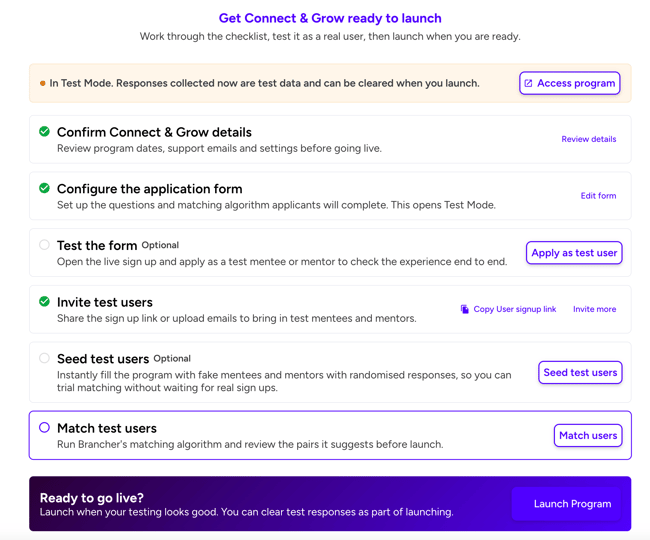
Once your goals and structure are decided, setup and launch inside Brancher follows a clear sequence:
- Confirm your program details. Review your program's dates, support email address, and settings before anything goes live, so applicants see accurate information from their first interaction with the program onward.
- Configure the application form. Set up the questions mentors and mentees will answer when they apply, along with the criteria the matching algorithm will use. Saving this step opens Test Mode, so nothing collected before launch counts as live data.
- Test the form yourself (optional, but worth doing). Open the live sign-up and apply as a test mentor or mentee to walk through the exact experience your participants will have, before a single real applicant sees it.
- Invite test users. Share the sign-up link directly, or upload a list of emails, to bring a small group of real colleagues in to trial the flow alongside you.
- Seed test users (optional). If you want to trial the matching algorithm before waiting on real sign-ups, Brancher can instantly populate the program with sample mentee and mentor profiles with randomised responses.
- Match your test users. Run the matching algorithm and review the pairs it suggests, this is your chance to sanity-check the logic against your actual criteria before it runs on real participants.
- Launch. Once testing looks good, launch the program. Test responses are cleared as part of launching, so your reporting starts clean from day one.
Step 5: Support Paired Mentors and Mentees
Matching people isn't the finish line, without ongoing support, structured mentoring relationships tend to fade. This means:
- Providing learning resources and light training for both mentors and mentees
- Helping mentees set goals and prepare for early meetings
- Checking meeting frequency and stepping in if a pair has gone quiet
- Having a process to resolve relationship issues
- Gathering anonymous feedback through regular check-ins
A mentoring agreement at the start of the relationship gives both parties something concrete to refer back to if expectations become misaligned later.
Step 6: Track and Report on Progress
Continuously check whether pairs are actually meeting and making progress, rather than waiting until the program ends to find out. Brancher's dashboards and built-in tools give administrators visibility into engagement and outcomes throughout the program, not just a satisfaction score at the end. Reporting continuously, rather than retrospectively, is what lets you catch a struggling pair early enough to actually help it.
Getting Started
None of the steps above need to happen all at once, and there's no single right time to begin. The organisations that get the most out of mentoring tend to start smaller and more deliberately rather than waiting for the perfect moment or the perfect headcount to justify it.
If you're weighing up what this would actually look like for your organisation, we're happy to talk it through. Book a no-obligation demo and we can look at your goals, your context, and whether a mentoring program is genuinely the right fit before you commit to anything.
Frequently Asked Questions
Where can I find software to track mentoring progress and outcomes?
Dedicated mentoring platforms, including Brancher, typically include built-in dashboards for this rather than requiring a separate tool: tracking meeting frequency, pulse/connection scores, goal progress, and satisfaction survey results across every pair in a program. Brancher's dashboards and automated feedback tools let administrators see this in real time throughout the program rather than only compiling it at the end. Outside of dedicated mentoring software, a shared spreadsheet with regular manual check-ins can work for smaller programs, though it doesn't scale well past a few dozen pairs.
How do I choose a robust software platform for managing mentor-mentee relationships?
Look for a few things specifically: a matching methodology that goes beyond simple availability or skills tags, admin dashboards that give visibility into every pair (not just aggregate stats), security and compliance credentials appropriate to your sector (Brancher, for example, is AWS-hosted, GDPR compliant, and WCAG 2.0 AA accessible), and evidence the vendor has run programs at your organisation's scale before. Best mentoring software in 2026 compares fifteen platforms against these criteria if you're evaluating options.
What are the typical costs associated with implementing a company-wide mentoring program?
Dedicated mentoring software is usually priced per user per month or as an annual enterprise licence; Brancher's published pricing starts from AUD $20 per user per month, or from AUD $15,000 per year for an enterprise arrangement. Beyond the software itself, budget for administrator time (heaviest in the first few months), any training materials or workshops, and incentives or recognition for mentors. How much does mentoring software cost breaks down the full pricing picture, including what tends to get missed in an initial budget.
Do I need mentoring software to start a program?
No, a small program can run on a spreadsheet and manual coordination, and the steps above still apply either way. Software becomes the more practical option once you're past roughly ten to twenty pairs, manual matching, tracking, and check-ins get genuinely difficult to sustain at that scale, and it's where most unmanaged programs start to quietly fail.
How long does it take to launch a mentoring program?
Launch timelines usually run from a few weeks to a few months, and most of that time sits in defining goals and securing leadership buy-in rather than in the technical setup itself. Using dedicated software like Brancher, the setup and testing sequence, configuring the application form, testing the sign-up flow, seeding and matching test users, typically takes days rather than weeks once your goals and structure are already decided.
Author Bio
Holly Brailsford is the Co-Founder and CEO of Brancher, and a registered organisational psychologist. She founded Brancher to bring an evidence-based, personality- and values-driven approach to workplace mentoring, and works with organisations across government, enterprise and the not-for-profit sector to design mentoring programs that deliver measurable outcomes.
Sources
- HR.com. (2022, June). Mentoring in the Workplace 2022: Use mentoring programs to develop leadership, engage employees, and improve organizational performance. https://www.hr.com/en/resources/free_research_white_papers/mentoring-in-the-workplace-2022-report_l3wmxpny.html
- LinkedIn Learning, 2025 Workplace Learning Report