Organisations & Enterprise
 Government
.png?width=20&height=20&name=icon%20(1).png) Universities
Universities.png?width=20&height=20&name=icon%20(2).png) Associations & Communities
Associations & Communities Increase Employee Engagement
.png?width=20&height=20&name=icon%20(3).png) Reduce Employee Turnover
Reduce Employee Turnover.png?width=20&height=20&name=icon%20(4).png) Provide Leadership Development
Provide Leadership Development.png?width=20&height=20&name=icon%20(5).png) Develop High Potentials
Develop High Potentials.png?width=20&height=20&name=icon%20(6).png) Boost Diversity, Equity & Inclusion
Boost Diversity, Equity & Inclusion.png?width=20&height=20&name=icon%20(7).png) Support Career Development
Support Career Development.png?width=20&height=20&name=icon%20(8).png) Drive Collaboration & Innovation
Drive Collaboration & Innovation.png?width=20&height=20&name=icon%20(9).png) Onboard New Staff & Graduates
Onboard New Staff & Graduates Brancher Mentoring Software
 Strengths & Values Analyzer
 Mentoring Program
 Reverse Mentoring
 Group Mentoring

 Organisations & Enterprise
 Government
.png?width=21&name=icon%20(1).png) Universities
Universities.png?width=21&name=icon%20(2).png) Associations & Communities
Associations & Communities Increase Employee Engagement
.png?width=21&name=icon%20(3).png) Reduce Employee Turnover
Reduce Employee Turnover.png?width=21&name=icon%20(4).png) Provide Leadership Development
Provide Leadership Development.png?width=21&name=icon%20(5).png) Develop High Potentials
Develop High Potentials.png?width=21&name=icon%20(6).png) Boost Diversity, Equity & Inclusion
Boost Diversity, Equity & Inclusion.png?width=21&name=icon%20(7).png) Support Career Development
Support Career Development.png?width=21&name=icon%20(8).png) Drive Collaboration & Innovation
Drive Collaboration & Innovation.png?width=21&name=icon%20(9).png) Onboard New Staff & Graduates
Onboard New Staff & Graduates Mentoring Software
 Strengths & Values Analyzer
 Peer Mentoring
 Reverse Mentoring
 Group Mentoring
 HR Mentoring Program
If you're researching mentoring software for your organisation, you've probably noticed the terms "mentoring platform," "mentoring app," and "mentoring system" get used almost interchangeably. They're not quite the same thing.
This guide breaks down what a mentoring platform specifically does, why the matching methodology behind it matters more than most buyers realise, and what to look for before you commit to one — using Brancher's own platform as the working example throughout, since it's built specifically around solving these problems for Australian and New Zealand organisations.
TL;DR
A mentoring platform centralises the parts of a mentoring program that are painful to run manually: matching, scheduling, structured guidance, and reporting. What separates a strong platform from a basic tool is how much of that is genuinely automated, and how deep its matching methodology goes.
Brancher was built by an organisational psychologist specifically to solve this. Its AI matches on personality and values alongside skills and goals (not just job title or availability) producing a matching satisfaction score above 97% across programs. Its automation (including Ava AI, its built-in AI coach) reduces admin time by up to 80%, and its Enterprise plan comes with a dedicated mentoring expert and an ROI guarantee tied to measurable outcomes.
Table of Contents
- What a Mentoring Platform Actually Does
- Why Matching Methodology Is the Feature That Matters Most
- Features Worth Asking About (and How Brancher Delivers Them)
- How to Evaluate a Platform Before Committing
- Frequently Asked Questions
- Choosing a Mentoring Platform that Works for You
What a Mentoring Platform Actually Does
At its core, a mentoring platform centralises the parts of a mentoring program that are painful to run manually: matching mentors with mentees, scheduling sessions, delivering structured guidance and training, and reporting on outcomes.
The difference between a genuinely useful platform and a glorified calendar tool comes down to how much of that is actually automated versus left for a program coordinator to chase up by email.
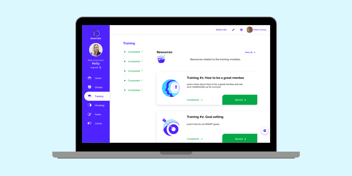
Brancher's platform, for example, handles enrolment, matching, meeting scheduling and reminders, and progress reporting in one system. Layered on top is Ava AI, an always-on AI coach built into the platform that gives mentors and mentees 24/7 prompts, reflection questions and resources between sessions so participants stay engaged without a coordinator having to manually check in.
Why Matching Methodology Is the Feature That Matters Most
Most platforms match participants on surface-level criteria — job title, department, stated interests. That produces pairs who are logistically compatible but not necessarily a good fit.
Brancher goes a step further and matches on personality and values alongside skills and goals, on the theory that compatibility of working style and outlook is what actually predicts whether a mentoring relationship sticks. This is powered by Brancher's own Strengths & Values Analyser, an optional add-on that gives participants a DISC-style profile of their strengths, values, motivators and blockers before they're matched, so the algorithm has more than a job title to work with.
Brancher's approach produces a matching satisfaction score above 97% across programs, which is a useful benchmark to ask any vendor you're evaluating to match or explain. On Brancher's Enterprise plan, the matching algorithm is also fully customisable, so program admins can weight criteria differently depending on whether the goal is leadership development, retention, or onboarding.
Features Worth Asking About (and How Brancher Delivers Them)
- Matching depth: Does it go beyond job title and availability, or is that all it considers? Brancher matches on personality, values, skills and goals, backed by its Strengths & Values Analyser.
- Automation: Are reminders, scheduling, and training delivery automated, or does an admin still need to chase people manually? Brancher automates enrolment, matching, meeting reminders and reporting, and adds Ava AI for 24/7 participant support — customers report up to 80% less manual admin time.
- Reporting: Can the platform produce engagement and outcome data your leadership team will actually find credible? Brancher provides real-time dashboards covering match health, engagement, goal progress and program ROI, exportable for executive reporting.
- Accessibility and security: Is it WCAG-compliant? Where is data stored, and under what compliance framework? Brancher is WCAG 2.0 AA compliant, hosted on AWS (with Ava AI data specifically held in AWS Sydney), undergoes annual penetration testing, and complies with the Australian Privacy Act 1988 and GDPR.
- Program flexibility: Does it support the format you need (1:1, group, peer, or reverse mentoring) or just one? Brancher supports 1:1, group, peer, reverse and cohort-based mentoring within a single platform, so you're not locked into one format as your program grows.
How to Evaluate a Platform Before Committing
Ask for a trial cohort or pilot group rather than rolling out org-wide immediately. Brancher Core is available as a self-service plan with a free trial, which makes it straightforward to test the platform on a smaller program before scaling up to Brancher Enterprise.
Look at whether the vendor is willing to commit to a measurable outcome rather than just describing features in the abstract. Brancher offers an ROI guarantee tied to admin time saved or retention improvement, and Enterprise customers are assigned a dedicated customer success manager and mentoring expert to guide design, launch and optimisation; not just a support ticket queue.
If you want to see how Brancher stacks up against 14 other named vendors on pricing, integrations and security certifications, our full comparison of the best mentoring software in 2026 walks through all of it, vendor by vendor.
Frequently Asked Questions
What's the difference between a mentoring platform and a mentoring app?
"Platform" typically refers to the full system (matching, admin dashboards, reporting) while "app" usually refers to the participant-facing mobile experience within that platform. Most modern tools, including Brancher, are both: a platform with a mobile-friendly app layer for participants.
Do mentoring platforms integrate with existing HR software?
Most enterprise-grade platforms do, though integration depth varies significantly. Brancher integrates with HRIS systems, Outlook and Google calendars, and Microsoft Teams, with SSO available on the Enterprise plan — worth confirming during evaluation rather than assuming any vendor's integrations match your stack.
Is personality-based matching worth paying more for?
If retention of the mentoring relationship itself is a priority (not just getting pairs matched, but keeping them engaged for the full program) matching methodology is usually the single biggest driver of that outcome. Brancher's personality-and-values matching is core to its Core and Enterprise plans (not a paid add-on), while the Strengths & Values Analyser adds an extra layer of depth for organisations that want it.
What does Ava AI actually do?
Ava is Brancher's built-in AI coach, available 24/7 through the platform. It gives participants personalised prompts, helps them prepare for and reflect on mentoring conversations, and keeps goals front of mind between sessions — reducing the load on both mentors and program administrators without replacing the human mentoring relationship.
Choosing a Mentoring Platform that Works for You
Brancher's platform was built around this exact question: how to make matching genuinely predictive of a good mentoring relationship, not just administratively convenient.
See how Brancher's matching works.
Related Reading
- Best Mentoring Software in 2026: A Buyer's Guide to 15 Platforms Compared
- The Ultimate Mentoring Platform Comparison: Brancher vs Together vs Chronus vs Mentorloop