Organisations & Enterprise
 Government
.png?width=20&height=20&name=icon%20(1).png) Universities
Universities.png?width=20&height=20&name=icon%20(2).png) Associations & Communities
Associations & Communities Increase Employee Engagement
.png?width=20&height=20&name=icon%20(3).png) Reduce Employee Turnover
Reduce Employee Turnover.png?width=20&height=20&name=icon%20(4).png) Provide Leadership Development
Provide Leadership Development.png?width=20&height=20&name=icon%20(5).png) Develop High Potentials
Develop High Potentials.png?width=20&height=20&name=icon%20(6).png) Boost Diversity, Equity & Inclusion
Boost Diversity, Equity & Inclusion.png?width=20&height=20&name=icon%20(7).png) Support Career Development
Support Career Development.png?width=20&height=20&name=icon%20(8).png) Drive Collaboration & Innovation
Drive Collaboration & Innovation.png?width=20&height=20&name=icon%20(9).png) Onboard New Staff & Graduates
Onboard New Staff & Graduates Brancher Mentoring Software
 Strengths & Values Analyzer
 Mentoring Program
 Reverse Mentoring
 Group Mentoring

 Organisations & Enterprise
 Government
.png?width=21&name=icon%20(1).png) Universities
Universities.png?width=21&name=icon%20(2).png) Associations & Communities
Associations & Communities Increase Employee Engagement
.png?width=21&name=icon%20(3).png) Reduce Employee Turnover
Reduce Employee Turnover.png?width=21&name=icon%20(4).png) Provide Leadership Development
Provide Leadership Development.png?width=21&name=icon%20(5).png) Develop High Potentials
Develop High Potentials.png?width=21&name=icon%20(6).png) Boost Diversity, Equity & Inclusion
Boost Diversity, Equity & Inclusion.png?width=21&name=icon%20(7).png) Support Career Development
Support Career Development.png?width=21&name=icon%20(8).png) Drive Collaboration & Innovation
Drive Collaboration & Innovation.png?width=21&name=icon%20(9).png) Onboard New Staff & Graduates
Onboard New Staff & Graduates Mentoring Software
 Strengths & Values Analyzer
 Peer Mentoring
 Reverse Mentoring
 Group Mentoring
 HR Mentoring Program
AI mentoring is one of those phrases that gets used to mean several different things at once, and if you're a program administrator being asked by leadership whether you "have an AI strategy for mentoring," that ambiguity is likely part of the frustration. This guide cuts through it. We'll define what AI mentoring actually covers, where it tends to add real value, what to look for if you're evaluating tools, and whether it's genuinely something your program needs, or just something it's fashionable to claim.
TL;DR
AI mentoring uses matching algorithms, natural language processing or generative AI to support a human mentoring relationship, handling matching, admin and between-session engagement rather than replacing the mentor. The judgement and lived experience a mentee actually needs still come from a person; AI's job is removing the friction around that relationship, not sitting inside it.
Whether it's worth adopting depends more on program size than fashion. A small, single-cohort program can run well without it. Once a program scales past the point where one administrator can personally track every match, AI-assisted matching and automated engagement tracking stop being a nice-to-have and start being what keeps the program's own monitoring from quietly falling behind.
Table of Contents
- What Is AI Mentoring?
- How Does AI-Driven Mentorship Differ From Human Mentorship?
- What Features Should You Look For in an AI Mentoring Tool?
- How Can AI Provide More Personalised Career Guidance?
- Best Practices for Implementing AI Mentoring in Your Team
- Finding an AI Mentoring Solution for Corporate Training
- Frequently Asked Questions
What Is AI Mentoring?
AI mentoring is the use of artificial intelligence, usually machine matching, natural language processing, or generative AI, to support a human mentoring relationship. It typically handles matching, administrative tasks, and in-between-session support. It does not, in any credible implementation, replace the mentor.
That distinction matters more than it might seem. "AI mentoring" can sound like it means a chatbot standing in for a human mentor. In practice, across every serious application of it, AI sits around the human relationship rather than inside it.
- It matches people more precisely than manual pairing usually allows. It nudges participants when engagement drops.
- It turns a stack of open-text survey responses into a summary a busy HR lead can actually read in five minutes.
None of that requires AI to hold a conversation on a mentor's behalf.
How Does AI-Driven Mentorship Differ From Human Mentorship?
AI-driven mentorship supports the logistics and structure around a relationship, while human mentorship supplies the judgement, empathy, and lived experience that a mentee is actually there for. The two aren't competing models. The most effective programs tend to use AI to strengthen the human relationship, not substitute for it.
A mentor brings something AI cannot: they've actually navigated the situation the mentee is facing. They can read a pause in a conversation and know it means something. They can offer a piece of career advice shaped by the specific politics of your organisation, something no general-purpose AI tool has visibility into.
AI's role is narrower and, honestly, less glamorous: it removes friction so that human judgement gets applied to the parts of the relationship that actually need it, rather than being spent on scheduling and chasing people for feedback forms.
What Features Should You Look For in an AI Mentoring Tool?
Prioritise AI-assisted matching based on goals and compatibility, automated engagement tracking that flags disengaging pairs early, reporting that turns raw activity data into something you can present to leadership, and an AI coach that personalises its prompts using each participant's own data rather than sending the same message to everyone. The distinction that matters isn't "has a chatbot or doesn't" — it's whether that chatbot actually knows anything about the individual it's talking to.
|
Feature category |
What it should do for you |
|
Matching |
Pairs mentees and mentors on goals, skills, and compatibility, not just availability |
|
Engagement monitoring |
Flags pairs with falling pulse scores or missed sessions before a mentee disengages |
|
Reporting |
Converts participation and survey data into dashboards you can show stakeholders without manual compilation |
|
AI coach / nudges |
Uses each participant's profile, goals, and progress to send personalised reminders and prompts, instead of the same generic email going out to the whole cohort |
|
In-session support |
Suggests meeting agendas or conversation prompts based on stated goals |
|
Qualitative analysis |
Summarises open-text feedback so themes surface without reading every response by hand |
Not every program needs every row on that list from day one. A smaller cohort may get most of its value from matching and reporting alone.
What's worth avoiding is a tool whose "AI coach" is really a generic chatbot bolted on for marketing purposes, one that sends the same scripted nudge to every participant regardless of their goals, their working style, or where they actually are in the relationship. That's the feature to scrutinise most closely in a demo, not the one to dismiss.
How Can AI Provide More Personalised Career Guidance?
AI can personalise guidance by analysing a mentee's stated goals, skills, and progress data to suggest relevant resources, structure meeting agendas around what they're actually working on, and flag when a goal has stalled across several sessions. It works from the data a mentee provides, rather than general assumptions about their role or level.
This is where AI genuinely extends what a mentor can offer, rather than replacing it. A mentor meeting a mentee once a fortnight can't track every signal between sessions. AI can. If a mentee's goal hasn't moved in two consecutive check-ins, that pattern is worth surfacing to both the mentor and the administrator, and a person juggling dozens of other responsibilities may simply not catch it unaided.
The guidance itself, what to actually do about a stalled goal, still comes from the mentor. AI's contribution is making sure the right moment to have that conversation doesn't get missed.
Best Practices for Implementing AI Mentoring in Your Team
Start with one use case rather than everything at once, usually matching or engagement tracking, and validate it before expanding. Keep mentors informed about what the tool is doing with their data, and treat AI output as a prompt for human judgement, not a replacement for it.
A few things tend to separate a smooth rollout from a bumpy one:
- Introduce it as support, not surveillance. Mentors and mentees should understand that engagement tracking exists to catch struggling pairs early, not to police them.
- Pilot before you scale. Run AI-assisted matching with one cohort before rolling it out organisation-wide, so you can catch mismatches in your own data rather than a vendor's generic model.
- Keep a human in the loop on every match. AI-suggested matches are a recommendation, not a final decision. An administrator reviewing and confirming each one catches context the algorithm doesn't have.
- Revisit your success metrics after the first cycle. What you measure before AI (session counts, satisfaction scores) may need to expand to capture what AI is actually changing, such as time to first meeting or pairs flagged and saved.
Finding an AI Mentoring Solution for Corporate Training
For most organisations, the simplest route isn't stitching together a generic AI tool and a separate mentoring spreadsheet. It's choosing a mentoring platform with AI built into matching, engagement tracking, and reporting from the ground up, since that avoids the data-integration problem entirely.
This is where we'd point to our own approach, so take it as exactly that rather than a neutral recommendation. Brancher's matching starts with personality and values compatibility rather than skills or availability alone, which is a different foundation to build AI-assisted matching on than most platforms use. Dashboard reporting then connects participant activity directly to the KPIs and goal data administrators are usually asked to report on.
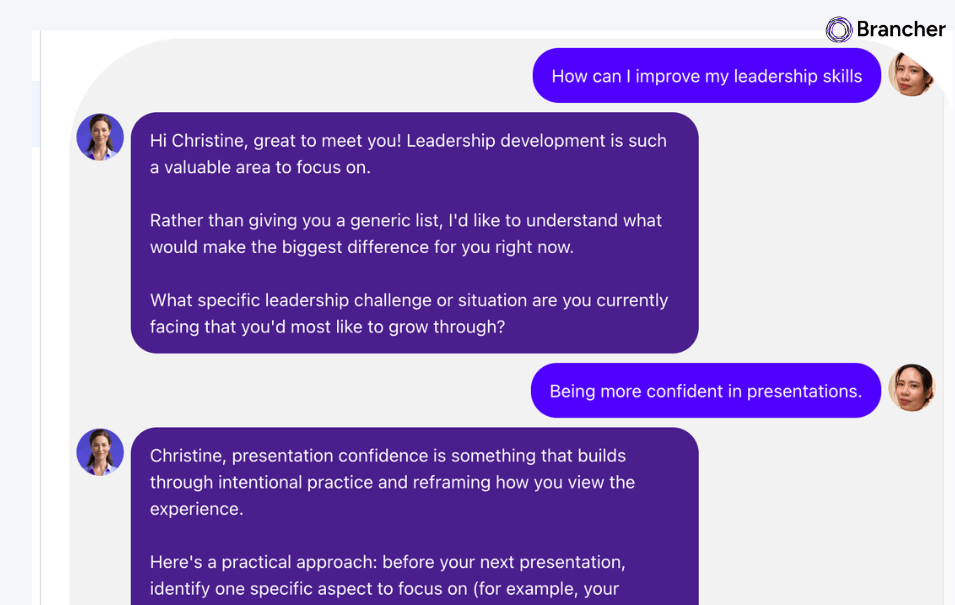
Sitting inside that platform is Ava, which we've built as what we believe is the first AI coach embedded directly into mentoring software, rather than bolted on as a generic chat widget.
- Always-on support between sessions. Participants can message Ava 24/7 for personalised prompts, reflection questions, and guidance tied to their own program goals, rather than waiting weeks for the next scheduled catch-up.
- Nudges based on who someone actually is, not a mailing list. Ava draws on each participant's personality and values profile, including how they prefer to communicate and their working style, alongside where they are in the mentoring relationship and their individual goals and challenges. The reminders and prompts it sends are shaped by that data, which is a different experience to the same generic check-in email landing in every inbox across the cohort on the same day.
- Context, not generic advice. Ava is pre-trained on Brancher's mentoring frameworks and can be enhanced with an organisation's own program documents, so guidance reflects your specific context rather than a one-size-fits-all script.
- Lighter load on mentors. By handling preparation prompts and reflection nudges, Ava reduces how much of the in-between-session work falls on the mentor directly, which may help with the mentor fatigue many programs struggle to avoid.
- Privacy built in, not bolted on. Only a participant's first name, role, and typed questions are processed. Data is encrypted and hosted in AWS Sydney, and chat history can be deleted on request. Ava is designed to align with the Australian Privacy Act and GDPR, which matters if you're taking this to a privacy or legal team for sign-off.
Ava is an optional add-on to Brancher's Professional and Enterprise plans, and can be switched on or off at the program level, so it's not an all-or-nothing commitment if you're still deciding whether your program is ready for it.
Book a demo if you'd like to see how the matching, reporting, and Ava pieces work together in practice.
Frequently Asked Questions
Where can I find AI mentoring programs or tools?
Rather than searching for standalone "AI mentoring" products, most administrators get better results evaluating full mentoring platforms that include AI-assisted matching, engagement tracking, and reporting natively. A platform built around AI from the start, like Brancher, typically integrates more cleanly than adding a separate AI layer to existing mentoring software.
Will AI replace human mentors?
No credible implementation of AI mentoring is designed to replace the mentor. AI supports matching, logistics, and between-session engagement. The judgement, empathy, and organisational context a mentor provides remain entirely human, and that's unlikely to change regardless of how capable the underlying AI tools become.
Is AI mentoring only worth it for large organisations?
Not exclusively, but the case strengthens with scale. Smaller programs may see modest benefit from AI-assisted matching alone. Larger or fast-growing programs tend to see the clearest return, since manual tracking of dozens of matches against multiple engagement metrics becomes genuinely difficult to sustain by hand.
Author Bio
Holly Brailsford is the co-founder and CEO of Brancher and a registered organisational psychologist specialising in workplace mentoring design. She works directly with program administrators across enterprise, government and university mentoring programs on the full lifecycle of a program, from the first match through to how a cohort should close, drawing on patterns she's seen play out across hundreds of program cycles.