Organisations & Enterprise
 Government
.png?width=20&height=20&name=icon%20(1).png) Universities
Universities.png?width=20&height=20&name=icon%20(2).png) Associations & Communities
Associations & Communities Increase Employee Engagement
.png?width=20&height=20&name=icon%20(3).png) Reduce Employee Turnover
Reduce Employee Turnover.png?width=20&height=20&name=icon%20(4).png) Provide Leadership Development
Provide Leadership Development.png?width=20&height=20&name=icon%20(5).png) Develop High Potentials
Develop High Potentials.png?width=20&height=20&name=icon%20(6).png) Boost Diversity, Equity & Inclusion
Boost Diversity, Equity & Inclusion.png?width=20&height=20&name=icon%20(7).png) Support Career Development
Support Career Development.png?width=20&height=20&name=icon%20(8).png) Drive Collaboration & Innovation
Drive Collaboration & Innovation.png?width=20&height=20&name=icon%20(9).png) Onboard New Staff & Graduates
Onboard New Staff & Graduates Brancher Mentoring Software
 Strengths & Values Analyzer
 Mentoring Program
 Reverse Mentoring
 Group Mentoring

 Organisations & Enterprise
 Government
.png?width=21&name=icon%20(1).png) Universities
Universities.png?width=21&name=icon%20(2).png) Associations & Communities
Associations & Communities Increase Employee Engagement
.png?width=21&name=icon%20(3).png) Reduce Employee Turnover
Reduce Employee Turnover.png?width=21&name=icon%20(4).png) Provide Leadership Development
Provide Leadership Development.png?width=21&name=icon%20(5).png) Develop High Potentials
Develop High Potentials.png?width=21&name=icon%20(6).png) Boost Diversity, Equity & Inclusion
Boost Diversity, Equity & Inclusion.png?width=21&name=icon%20(7).png) Support Career Development
Support Career Development.png?width=21&name=icon%20(8).png) Drive Collaboration & Innovation
Drive Collaboration & Innovation.png?width=21&name=icon%20(9).png) Onboard New Staff & Graduates
Onboard New Staff & Graduates Mentoring Software
 Strengths & Values Analyzer
 Peer Mentoring
 Reverse Mentoring
 Group Mentoring
 HR Mentoring Program
Last Updated: 17 August 2026
Quick answer: A great mentee sets clear goals, comes to every session prepared, listens actively, acts on feedback, and takes initiative between meetings instead of waiting to be guided. Being a great mentee isn't about being the perfect student. It's about treating the relationship as a partnership you're actively driving, not a service you're passively receiving.
Most people join a mentoring program focused on finding the right mentor. Fewer stop to think about what they bring to the relationship. But research consistently shows the mentee's behaviour, not just the mentor's experience, is what determines whether a mentoring relationship actually works.
This guide covers the qualities that make someone a great mentee, how to prepare for your first meeting, the mistakes that quietly undermine mentoring relationships, and what the research says about why this effort pays off.
TL;DR
- A great mentee sets clear goals, listens actively, takes initiative, stays open to feedback, and shows genuine appreciation for their mentor's time.
- The mentee's behaviour has a bigger influence on mentoring outcomes than most people expect. Formal, well-structured mentoring relationships consistently outperform informal ones.
- Preparation for a first meeting matters more than any single quality. Reflect on your goals, fill out a mentoring agreement if your program has one, and bring two or three talking points.
- The biggest mistake mentees make is treating mentoring as something that happens to them rather than something they help create.
Table of Contents
- What Are the Key Qualities of an Excellent Mentee?
- Goal Clarity Comes First
- Active Listening and Open Communication
- Initiative and Ownership
- Coachability and Openness to Feedback
- Showing Appreciation and Reciprocity
- How to Prepare for a First Meeting With a Professional Mentor
- Common Mistakes That Undermine a Mentee's Progress
- Why Being a Great Mentee Pays Off
- How Brancher Helps Mentees Show Up Prepared
- Frequently Asked Questions
What Are the Key Qualities of an Excellent Mentee?
Quick answer: The key qualities of an excellent mentee are goal clarity, active listening, initiative, coachability, follow-through, respect for the mentor's time, and genuine gratitude. These aren't personality traits you're born with. They're habits you can build from your very first session.
Here's what each one looks like in practice:
| Quality | What it looks like in practice |
|---|---|
| Goal clarity | You can describe what you want from the relationship in one or two sentences, and you've discussed it with your mentor. |
| Active listening | You put your phone away, ask follow-up questions, and don't spend the conversation planning what to say next. |
| Initiative | You reach out first, set up meetings, and come with an agenda rather than waiting to be asked "so, what's new?" |
| Coachability | You ask for honest feedback and don't get defensive when it's not entirely positive. |
| Follow-through | You act on what you discussed last time, and you say so at the start of the next session. |
| Respect for time | You show up on time, prepared, and you don't cancel at the last minute without good reason. |
| Gratitude | You acknowledge the time and effort your mentor is giving you, not just when the relationship ends but along the way. |
Goal clarity comes first
Before anything else, get specific about what you're hoping to get out of the mentorship. Vague goals like "I want to grow in my career" are hard for a mentor to act on. Specific goals like "I want to build the confidence to speak up in exec meetings" give your mentor something concrete to help with.
Reflect on your strengths, your gaps, and what you want to be different in six or twelve months. Then bring that to your mentor early and revisit it as you go, since goals often shift once the relationship is underway. If your organisation uses a mentoring agreement, this is exactly what it's designed to capture: expectations, boundaries, and goals, written down so neither of you is guessing.
Active listening and open communication
Active listening means giving your mentor your full attention and genuinely engaging with what they're saying, not just waiting for your turn to talk. Put the phone away. Ask questions that show you're following the thread. This does two things: it helps you actually absorb the advice, and it signals to your mentor that their time is being well spent.
Open, honest communication matters just as much. Share what's actually going on, including the parts that are harder to say out loud, like a setback or a mistake. Mentors can only help with what they know about.
Initiative and ownership
The mentees who get the most out of a program are the ones who drive it. That means being the one to reach out, set up meetings, and come with something specific to discuss. If you want to go a step further, send a short agenda before the meeting and a summary of key actions afterwards, so you both have a record to work from.
Initiative also shows up between sessions. Identify where you need support and ask for it directly, rather than waiting for your mentor to guess. Seek out resources on your own, whether that's an article, a course, or a conversation with someone else in your network. Taking ownership of your own development is one of the clearest signals to a mentor that the time they're investing is worthwhile.
Coachability and openness to feedback
A growth mindset (the belief that abilities can be developed through effort, not that they're fixed at birth) is one of the clearest predictors of who gets the most out of mentoring. Approach every conversation, including the uncomfortable ones, as a chance to learn something. If you'd like to go deeper on this idea, we've written about how a growth mindset shapes mentoring outcomes for both mentors and mentees.
Feedback is one of the most valuable things a mentor can offer, but only if you're genuinely open to hearing it. A few questions worth asking your mentor every three months or so:
- What progress have you noticed since we started working together?
- What areas do you think I've improved in the most?
- What should I focus on next?
- Have you noticed any patterns in how I work or communicate that I should know about?
- What's one piece of advice you'd give me right now?
The goal isn't to be perfect. It's to keep learning.
Showing appreciation and reciprocity
Mentoring is a two-way relationship, even when the mentor is more senior. A simple, specific thank you goes further than people expect: not just "thanks for your time" but "that advice on how to frame the promotion conversation actually changed how I approached it." Share your wins with your mentor and let them see the impact of their input. Where you can, look for ways to give back, whether that's offering a skill of your own or simply staying engaged and reliable.
How to Prepare for a First Meeting With a Professional Mentor
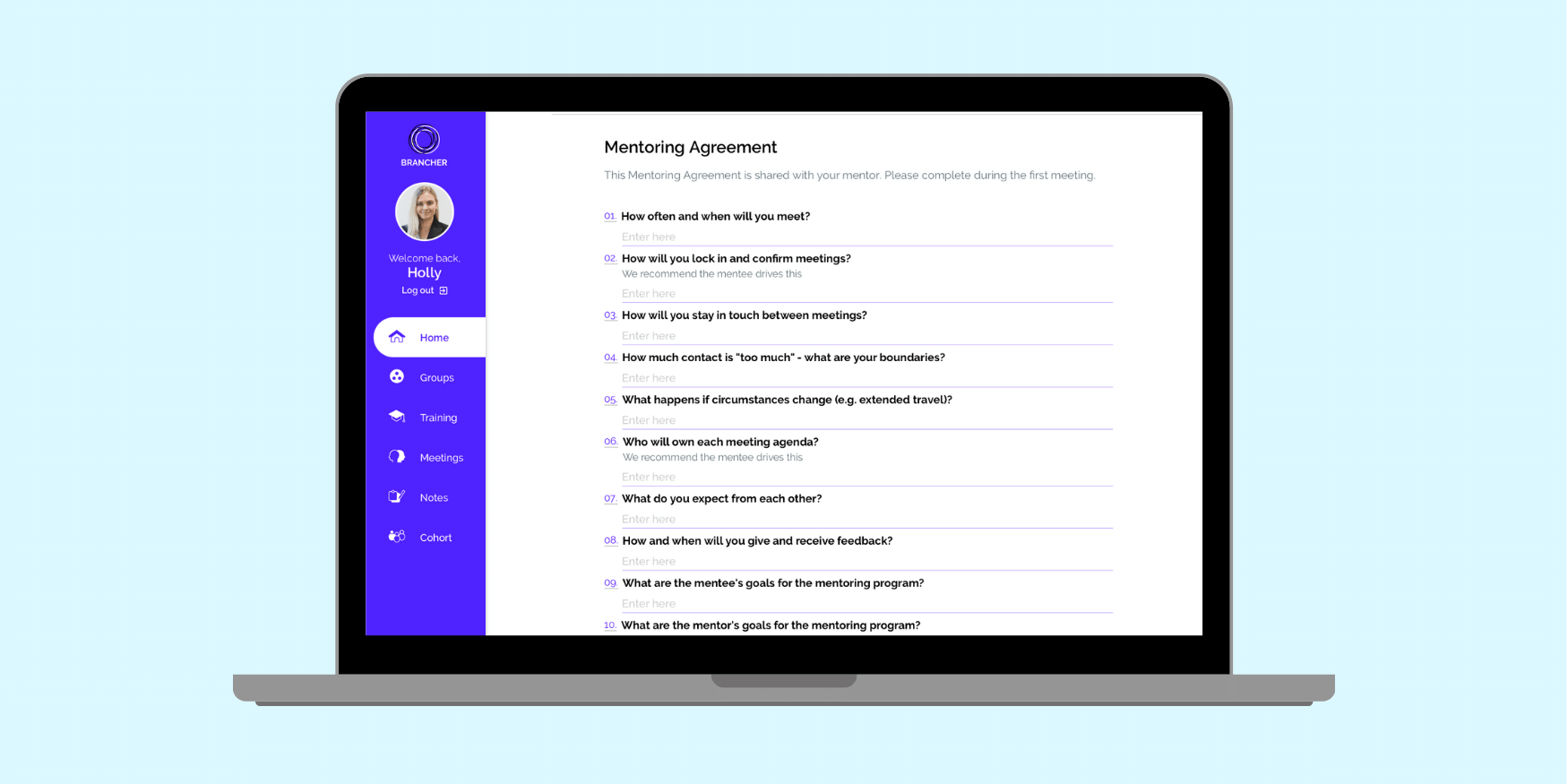
Quick answer: Prepare for your first mentor meeting by getting clear on one or two goals beforehand, filling out a mentoring agreement if your program has one, and bringing two or three specific talking points or questions. Preparation, more than any single personality trait, is what separates mentees who get real value from their program from those who don't.
Here's a simple checklist to work through before your first session:
| Before the meeting | Why it matters |
|---|---|
| Reflect on one short-term and one longer-term goal | Gives the conversation direction instead of drifting into small talk |
| Review your mentoring agreement, or start one | Sets shared expectations on meeting cadence, communication, and confidentiality upfront |
| Prepare 3 to 5 questions, not 30 | Depth beats quantity, especially in a first meeting |
| Think about what you can share, not just ask for | Mentoring works better as a two-way exchange from the start |
| Plan to send a short recap afterwards | Creates a record of what was discussed and what happens next |
A mentoring agreement is worth setting up before or during your first session if your program supports one. It covers the practical groundwork, meeting schedule, communication channels, confidentiality, and goals, so you're not figuring it out mid-conversation.
For the actual questions to bring, we've put together a full guide: 37 Questions to Ask Your Mentor During Your First Meeting. You don't need all 37. Most successful first meetings run on five to seven well-chosen ones.
If you're also unclear on what a mentor is and isn't there to do (spoiler: they're not a coach, a therapist, or a guaranteed door-opener to your next promotion), our guide on what a mentor actually does is worth a read before your first session so your expectations are realistic from day one.
Common Mistakes That Undermine a Mentee's Progress
Most mentoring relationships don't fail because of one big blow-up. They quietly underperform because of small, repeated habits. Watch out for these:
| Mistake | Better approach |
|---|---|
| Waiting for your mentor to drive every meeting | Come with an agenda and set the next meeting time yourself |
| Turning up without an update on last session's actions | Spend two minutes before each meeting reviewing what you committed to |
| Treating feedback as criticism | Ask a clarifying follow-up question instead of getting defensive |
| Expecting your mentor to open doors for you | Use their advice to build your own case, and let opportunities follow from that |
| Going quiet between sessions | A short check-in message keeps the relationship warm, even a one-line update |
| Oversharing sensitive personal issues | Keep the relationship focused on professional development, and lean on a manager, HR, or a mental health professional for anything outside a mentor's scope |
Why Being a Great Mentee Pays Off
The upside of doing this well isn't just anecdotal. A large-scale meta-analysis of workplace, academic, and youth mentoring research by Eby and colleagues found mentoring is consistently associated with favourable behavioural, career, and psychological outcomes for mentees, though the strength of that benefit depends heavily on the quality of the relationship itself, not simply on having a mentor assigned to you.
Gallup's research on workplace mentoring backs this up from a different angle. Only 40% of employees currently have a mentor at work, and employees with a mentor or sponsor are more than twice as likely to strongly agree their organization gives them a clear career development path.
The gap is even wider for formal, structured mentoring relationships: employees with a formal mentor are 75% more likely to say their organisation offers a clear development path, compared to those with an informal one. Employees with strong development support are also twice as likely to be engaged at work and 98% more likely to recommend their organisation as a great place to work.
The takeaway for mentees: Showing up prepared and engaged isn't just good manners. It's the difference between a mentoring relationship that moves your career forward and one that quietly fizzles out.
How Brancher Helps Mentees Show Up Prepared
Being a great mentee is mostly about mindset and habit, but the right tools make it easier to actually follow through.
- Mentoring Agreement: Brancher prompts mentors and mentees to discuss expectations, boundaries, and goals right at the start of the relationship, so nothing important gets left unsaid.
- Suggested talking points: Mentees get conversation starters and topic suggestions ahead of each session, which is especially useful when you're not sure what to bring to a meeting.
- Digital Meeting Minutes: Actions and takeaways are tracked from one session to the next, so follow-through (one of the biggest predictors of a good mentee) becomes part of the process instead of something you have to remember on your own.
- Mentee training portal: Brancher's bite-sized training modules walk mentees through goal setting, reflection, giving and receiving feedback, and how to wrap up a mentoring relationship well.
Book a demo with Brancher to see how the platform helps mentees and mentors get more out of every session.
Frequently Asked Questions
What's the difference between a mentor and a coach?
A mentor typically shares knowledge and experience and can be more directive, while a coach mostly asks questions to help you find your own answers and rarely tells you what to do. Read more in our guide on what a mentor does.
How often should a mentee meet with their mentor?
Most workplace mentoring relationships work well with one meeting a month, though this should be agreed between mentor and mentee and revisited if it's not working. Consistency matters more than frequency.
What if my mentor and I aren't a good fit?
Raise it early with your program administrator rather than letting the relationship fade out quietly. A structured matching process, based on goals, values, and working style rather than just job title, reduces the chance of a poor fit in the first place.
Should mentees give feedback to their mentors too?
Yes. Mentoring works best as a two-way relationship. Letting your mentor know what's helpful and what isn't makes the relationship stronger for both of you.
Do I need formal training to be a good mentee?
No, but it helps. Some organisations, including those using Brancher, offer short training modules for mentees covering goal setting, feedback, and reflection, which can shortcut a lot of trial and error.
Sources:
- Eby, L. T., Allen, T. D., Evans, S. C., Ng, T., & DuBois, D. L. (2008). Does mentoring matter? A multidisciplinary meta-analysis comparing mentored and non-mentored individuals. Journal of Vocational Behavior, 72(2), 254–267. https://pubmed.ncbi.nlm.nih.gov/19343074/
- Den Houter, K., & Maese, E. (2023, April 13). Mentors and Sponsors Make the Difference. Gallup. https://www.gallup.com/workplace/473999/mentors-sponsors-difference.aspx
Author Bio
Holly Brailsford is the co-founder and CEO of Brancher and a registered organisational psychologist. She works with organisations across Australia to design mentoring programs that produce measurable outcomes, drawing on the psychology of what actually makes a mentoring relationship work for both mentors and mentees.